I have my referenced values towards the bottom, but the top has some journal entries regarding my personal philosphies and life experience~ enjoy 🙂
July 14, 2026 ———————
When lost in depression, the world beyond is distant and blurred.
My experience with depression came largely from feeling disconnected from the life I wanted to live. I know everyone’s depression is different, but for me, some of my own choices and circumstances slowly pulled me away from myself. I have made life choices and involved myself in conflicting environments that have distanced me from my heart, my truth and my path, which I felt stuck in my form of depression / unhappiness, it sucked, until I started listening to my body in what it was telling me in relation to these choices, (I removed the rose colored glasses and saw my reality for what it really was) and started taking action to adjust,,,slowly, a process that took years. I am still scraping away at litlle pieces, or am shown things that still lie within me, but the cool thing is I can proudly say I have worked through a lot of it and have outgrown that time’s “hatred” or “discontent” for myself, and I have reestablised a loving relationship with me :-))
Sometimes our emotions mislead us. Sometimes our “heart” is wounded. Sometimes fear disguises itself as intuition. Sometimes the first step isn’t finding the answer,,,it’s creating enough quiet to notice what your heart, body, and conscience have been trying to tell you beneath all the noise.
Sometimes outside help, therapy, medication, or simply surviving are the first steps, now I personally found a majority of my therapy through processing in conversations with friends/peers and processing things myself through journalling and reading. I also tried Better Help for some time, which I did appreciate having someone certified who could listen to me process my thoughts and conflictions and offer little bits of wisdom/support to help me unjumble some things while I continued navigating life, it took some getting used to opening up to a stranger about my struggles, and I wasn’t a fan of talking on video chat haha, but I would absolutely consider therapy again if I felt I needed it.
While your light is dulled, look for others around you to borrow their light and guidance till you can get your light growing again (more confidence, more comfortable, and back on your path destined by your unique purpose). Borrow their light until you’re ready to rediscover your own. They can help recalibrate you on your path through a little conversation, or act as an example of what you want to work towards.
Depression can last a long time, for me I saw it when the mind/body and the heart of myself were disconnected,,,many reasons for this, your heart may be limited by the constraints/boundaries your life is in (environments such as work, family, friendships, outside interruption, or unhealthy vices/darkness you invite in) or may be wrapped within a life experience we go through. It feels as if we’re drowning in confusion, the heart is quieted and your mind feels forced to overwork to make ends meet, to make sense of it, you may feel constricted, suffocated, by an invisible grip of the life around you. Maybe even a feeling of being stuck.
I have learned, you cannot overthink depression. That reinforces it.
Now, getting through the darkness is complex, but sometimes getting space from your consistent life and reconnecting with your heart can help,,,so do something for yourself: what do you want to put some time towards? (passions/hobbies, different/fulfilling work, walking, enjoying the moment/friends/family, exploring, meeting new people, taking a break from other people, or even just slowing down in everything and just being), often the pressure we unknowingly signed up for (or that was brought in our lives) can pull you away from your truth and path, and additionally blur your clarity.
When you’re able, doing something for yourself ~ even something smalllllll ~ can begin to shift your perspective and reconnect you with parts of yourself that have felt quiet. It can help you get out of your head and into the present moment. You are the architect of your own life, so reflect on the structure and do what you need to redesign the layout so it is a life you enjoy….this may require work, but growth comes from addressing our challenges/faulty design and adjusting by redesigning our mind and actions within our days. It can be a vulnerable time! But this shift in your perspective can lead you back towards your truth, and may help in this time of darkness.
It is not easy, but you are capable. And also, remember, with all this hopeful/empowering talk I type, it’s ok to say “life just sucks sometimes and these things are out of my control”.
Give yourself grace and compassion, get to know this newer, you, give yourself the time, brick by brick you can redesign the life that you can come to enjoy <3
Also,
Have you considered how you can volunteer your time, talents and will to a community beyond you? Sometimes helping others can get us away from our internal challenges for some time. While doing something new can be scary, it WILL get your out of your head and into your body, in the world beyond you. Your community can be built by others that you adopt yourself into, and also collectively built by you. You have skills that can be welcomed somewhere, you do just need to get out there and find it.
My community is found in my town (at the schools I substitute at, at the tennis courts I coach at, of course my family & friends, and through my own hobbies/passions such as tennis, art, hiking, pursuing my masters, teaching/mentoring, adventuring and traveling). My other main community that gets me out of my head and distant from depression is Camp Conrad Chinnock, this is a summer camp for kids with diabetes. I have been going for 20 years as a camper turned staff member. This place challenges me in so many ways, but for the best of reasons. It’s like a small city, and without me camp is different, without campers there is no camp, without everyone involved there is no camp to learn and grow from…it is the people that make camp, and it is the people I go back for, and they come back for the people like me, and for the experiences associated.
We each are valued and loved at camp. We make the best of it and offer our hearts and skills for the greater mission, and for each other. This place values me like no other. I am not just filling a role or title, they take me in for ME! They value me and give me the space to connect with my skills, talents, insight, heart, light, quirkyness, efficiency, drive & voice, in which they are all valued and welcomed. I just have to be willing to grow and connect with it.
I feel heard and seen. Every room I walk in I get a wave, smile, hug, hello and everything else. What a gift. I am not TOLD what to do, instead I am empowered to be me and offer what I can for the collective community and it is a gift I get to give, that gives back to me.
Camp is my example of being apart of something greater than me, a community shared on a shared mission. Camp is a place to be my free-est self and live the most human experience I can! I feel seen! My purest self! This is also all an example of “Eudaimonic happiness” and even crosses with “ikigai” which I termed at the bottom of this page 😉 I guess I feel this in a way at the schools too, not as free but still a place where I am seen and valued, and where I do my best to provide that sense of togetherness and inclusivity to the kids I interact with, daily.
Sacrifice of oneself for others is not a heavy weight to hold you down, it is a gentle hand pushing you forward to grow into the greatest you, you can be. My friend Tucker from camp said that and it stuck (sTuckered lol) with me.
Sacrifice of your time, talent and personal will can help you recalibrate your light and shrink the darkness, we do this life for others AND for ourself, so find the balance. Depression can change. It can soften. It can become smaller over time. It may take time, so show yourself compassion on the long days, you can get through this, listen to your heart and go. I think the whole reason I am typing this is because I have seen healing in my life that I didn’t know was possible when I was engulfed by it, years ago. It feels pretty good to notice that positive change~~~~~
You are not alone on the collective human experience, but you are alone on your individual journey. This life is uniquely yours. Meet yourself with awareness instead of judgment. Your relationship with yourself is the longest and most enduring one you’ll ever know.
ALSO! Your light is waiting to be shared, there are so many people that have yet to meet you that you are going to love, and that are going to love you, just get out there, disrupt your patterns, and let the light guide you~ ~ Addie <3
May 11, 2026 ———————
We all have a light within us. This light is our goodness, our love, and our truest self,,,the place where our soul naturally rest, our peace.
We also all carry darkness. ALL OF US! This is part of being human and living within the collective experience of this world. In everything we do, we choose whether to let the light or the darkness work through us.
It is our conscious decision to be good and to do good. We must continually calibrate ourselves toward what is righteous and true, allowing the light to guide us and overcoming the darkness within.
The darkness is enticing. It is tempting….I have had my fair share of choices made with darkness. Some people have heard me say this and have told ME I don’t have darkness, it makes me uncomfortable because they are being ignorant AND I am no saint. I have had to learn to acknowledge these choices made in dark, forgive myself, and grow from them.
I do not follow one specific religion, but I draw wisdom from many spiritual traditions and ideals to make sense of my heart and my relationship with the “divine”. I find that the Seven Deadly Sins from Catholicism offer a meaningful framework for identifying where darkness can take hold in our lives: greed, pride, gluttony, lust, sloth, wrath, and envy.
Where do these tendencies show up in your life?
How are you making decisions that intertwine with any of these?
How are they harming you? Or others?
How are they distorting your perception?
We all experience life through the lens of our personal experiences. It is our responsibility to identify where darkness lives within us and to recalibrate our perception toward what is right, so that we can reconnect with our innate goodness.
As humans and as souls, it is our duty to work on ourselves and to live in harmony with those around us. If each of us commits to shifting toward the light, the world can change collectively. 🙂
This is not easy work!!!!!!
It is humbling, raw, uncomfortable, and sometimes embarrassing,,,but it is also deeply sweet and healing to acknowledge our shadows and grow beyond them.
We live in a world that often rewards selfishness. Many of our choices are influenced by subtle forms of greed, pride, gluttony, lust, sloth, wrath, and envy.
Practice noticing your darkness. This process is similar to shadow work, a concept popularized by Carl Jung. Become aware of the urges that tempt you, and learn to resist them. We spend so much time seeking fulfillment outside ourselves that we forget we already carry everything we truly need within.
Consider this on a collective level….
We live in a world shaped by consumerism, a system that does not merely meet our needs, but intentionally feeds our desires. It amplifies greed for money and possessions.
Money is a form of exchanged energy, yet it can also be used to manipulate people, steal their time, cloud their judgment, and distance them from what matters most.
When this is combined with envy and social media, we are often driven to make choices that distort our perception and block our inner light. It pins us against others and make them as a whole the enemy, crafted out of our insecurities.
Gluttony can manifest as overconsumption, not just of food, but clothing, entertainment, social media, or even information (politics is one I have seen personally in my family and friends, that is necessary,,,yet causes distortion).
Lust can lead us to seek another person to fill a void within ourselves, causing us to ignore red flags and abandon our intuition, intertwined with greed to satisfy our human bodies cravings via physical pleasure. Not all physical connections are bad, just when we do it with dark intentions.
Sloth keeps us distracted and disconnected from our purpose. Slows us down and harms our lights continuous energy.
Wrath blinds us, pulling us away from truth and recalibrating us further from the light. It is a distraction, so we lose sight of our willingness to communicate with others to uncover the truth and move forward with peace. Often intertwined with pride. It puts fear in others (fear is also a form of darkness), our wrath reinforces other’s darkness to hide their light.
Pride fuels them all by strengthening the ego, ego is the persona through which darkness often operates in our mind. The ego is the driver of our inaccurate individual life perception.
This is a broad interpretation, but it illustrates how our unchecked tendencies can harm both ourselves and the collective.
The good news is that awareness changes everything!!!!
When we courageously face our shadows, take responsibility for our choices, and return to the love and goodness within us, we begin to heal,,,not only ourselves, but the world around us. 🙂
When we face our inner darkness with honesty and compassion, we uncover the light that was there all along.
And remember: You are the light of the world, share your light, your truth and your love and the light will always win. ~Addie
April 15, 2026 ————————————-
People all run with different programing and at different frequencies. Always changing throughout the moments, and years, but there are higher frequencies that you naturally thrive at, in which you connect with your higher being, or inner self. See it as your true self or your light. The goodness and righteousness within you!!! The lower frequencies are doable to live with, but you do not thrive there.
I find I am shifting my frequencies, I have days or moments in lower frequencies, its a safer frequency, but often a time of darkness and stagnation, sometimes even fear. On the contrast, when I am embodying my truest self, I feel so alive!!! Life is great! Everything is amazing. My light is working and being shared in my actions and reality. That feeling in those moments is you working at your higher frequency.
I find I have been in the lower state for a long time, a few years now, it is a time of rawness and observation/learning/reflection/humbling/fear/recalibration/unknowns/darkness/depression, but I have had a transition in which it is shifting up and life has been constantly executed through my upper self. It uses more energy and presence, but in a way that is not costly and my soul pursues. I do not meditate often, but I do find moments to be with myself. I find I have been working on my breathing, releasing my fears and anxiety through breath, which is allowing me to quiet my mind some and not get stuck in the tussle of the whitewash, or tussle of the things I cannot control. Or get lost in the fear. More present and more forward thinking which leads to actions I connect with.
If you are reading this:
Do you slow down in life?
Do you sit with yourself?
Have you released your thoughts to just, be?
Be present?
Have you noticed the peace and compassion you have when you are present?
Are you living life for yourself?
Are you connecting with your wants and your passions?
Are you listening to your heart?
When was the last time you have danced?
When was the last time you watched the sun set?
Again,,,are you living your life for you?
Are you chained to something beyond you?
What can you shift, or release, to help realign this life to what you want it to be?
Sometimes I have to remind myself to chill, life will always keep going, so it is ok that I can take a break, and that is the nature of life. It is ok to stop doing for a bit and just be. We must release what does not serve us.
Life is good but you can’t force yourself to think that, you have to work to make your life a life you want.
Believe in living!
Create the life you enjoy waking up to, life is a GIFT! And you are the architect!
~Addie
December 25, 2025 —————————
These are words and saying that are from different cultures in which I have discoved and wrote down because I appreciated what they stood for. I wanted to share these sayings with whoever stumbles upon this page to reflect and appreciate what they offer in perspective and heart. Enjoy!
Ichi-go ichi-e (一期一会)
Ichi-go ichi-e is a Japanese four-character idiom meaning “one time, one meeting.” It emphasizes that every encounter is a unique, once-in-a-lifetime experience that can never be repeated in exactly the same way. Rooted in Zen Buddhism and the Japanese tea ceremony, the phrase encourages us to be fully present and to treasure each moment, whether with people or in everyday life, because circumstances, feelings, and time itself are always changing.
Ubuntu
“I am because we are.”
Ubuntu is a profound Southern African philosophy emphasizing that our humanity and identity are deeply interconnected. A person is a person through other people. It highlights community, compassion, and shared humanity over individualism, reminding us that individual well-being depends on the well-being of the collective. Ubuntu is a call for mutual respect, kindness, and the understanding that one person’s flourishing is tied to the flourishing of all.
Wabi-sabi
Wabi-sabi is a Japanese aesthetic and worldview centered on finding beauty in imperfection, impermanence, and incompleteness. It embraces the natural cycle of growth, decay, and weathering as signs of life and character rather than flaws. Drawing inspiration from Buddhist teachings on transience, wabi-sabi encourages simplicity, quietness, and harmony with nature, offering an alternative to Western ideals of perfection by honoring age, wear, and asymmetry in objects, landscapes, and life itself.
Tikkun Olam (תיקון עולם)
Tikkun olam is a Hebrew phrase meaning “repairing the world” or “healing the world.” It refers to the idea that people have a moral responsibility to make the world more just, compassionate, and whole through their actions. Tikkun olam suggests doing something with the world that not only fixes what is broken, but also improves upon it – helping prepare it for the state it is meant to become.
The world is imperfect – and you are not here by accident.
Your actions matter.
Repair happens piece by piece, person by person.
Hao La (好啦 / 好了)
Hao la is a commonly used Mandarin Chinese expression that can be translated as “it’s okay,” “all is well,” or “it’s getting better.” More than a phrase, hao la often carries a sense of reassurance and calm – an acknowledgment that things may be difficult now, but they are settling, softening, and moving toward balance.
Eudaimonia (εὐδαιμονία)
Aristotle, an influential philosopher in virtue ethics, claimed in Nicomachean Ethics that the goal of human life is eudaimonia, often translated as living well or human flourishing. He argued that eudaimonia is achieved through consistently practicing virtue over time. Acting virtuously meant choosing the mean – the balanced middle – between vices of excess and deficiency.
For example, courage lies between cowardice (deficiency) and recklessness (excess).
Central to Aristotle’s ethics is the idea that moral virtues such as courage, honesty, and wisdom are developed through habit and education. By repeatedly choosing virtuous actions with intention, individuals shape their character. Over time, Aristotle believed, people come to find genuine satisfaction and joy in living ethically.
Hedonic vs. Eudaimonic Happiness
Hedonic happiness focuses on pleasure, enjoyment, and positive feelings in the moment – such as savoring good food or laughing with friends. While these experiences are important, they are often short-lived and can lead to the hedonic treadmill, where people adapt and require more stimulation for the same level of happiness.
Eudaimonic happiness, by contrast, is rooted in meaning, purpose, and personal growth. It comes from living in alignment with values and contributing to something beyond oneself. Together, these two forms of happiness suggest that lasting well-being arises from balancing pleasure with purpose.
Ikigai (生き甲斐)
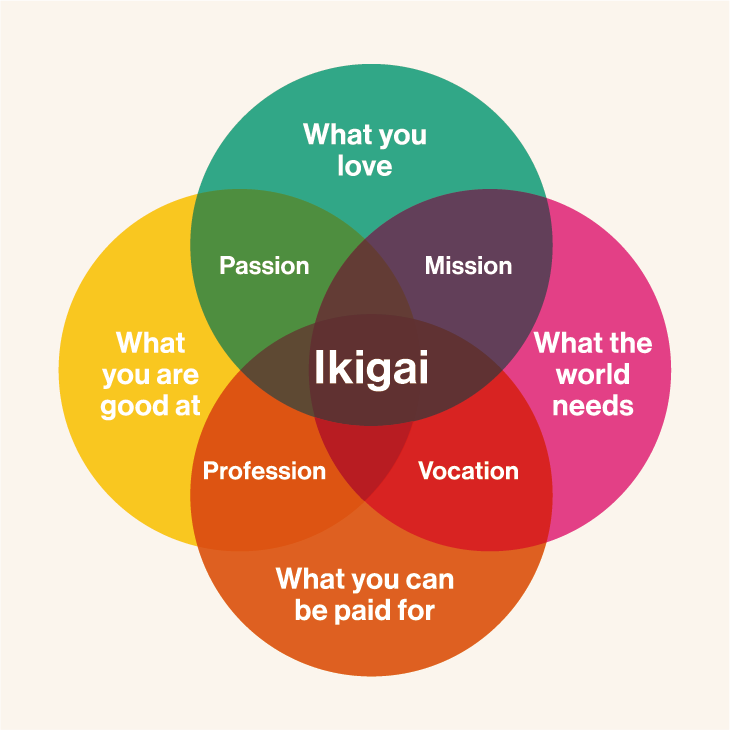
Ikigai is a Japanese concept meaning “a reason for being.” Derived from iki (life) and gai (value or worth), it represents purpose, passion, and what makes life feel worthwhile. Ikigai is often visualized as the intersection of what you love, what you’re good at, what the world needs, and what can sustain you. At its core, it points to finding fulfillment and joy in daily life, similar to the French idea of raison d’être.
Agape (ἀγάπη)
Agape is a Greek term describing selfless, unconditional, and sacrificial love. Often emphasized in Christian theology, it represents love as a conscious choice to seek the well-being of others, even in difficult circumstances. Unlike philia (friendship) or eros (romantic love), agape is benevolent and enduring – less a feeling and more a way of being that inspires goodwill and compassionate action.
The Shadow (Jungian Psychology)
The Shadow, a concept coined by psychologist Carl Jung, refers to the unconscious parts of our personality that we repress or reject. These may include instincts, fears, flaws, or socially unacceptable traits, but also forgotten strengths and creativity. Although hidden, the shadow influences behavior and often appears through projections onto others or in dreams. Jung believed that acknowledging and integrating the shadow is essential for personal growth and psychological wholeness.
Schema
Schema is a term from psychology and education (from the Greek schēma, meaning “form” or “shape”) referring to the inner mental framework through which we organize what we know, believe, and have experienced – a web of meaning shaped over time. Learning happens when new ideas connect to these existing schemas, sometimes reinforcing them and other times reshaping them. Because each person’s schema is formed through unique experiences, it influences not only how we learn, but how we interpret life itself; no two people understand or experience the world in exactly the same way.
la la la la laaaaaaa